Neighborhood
History
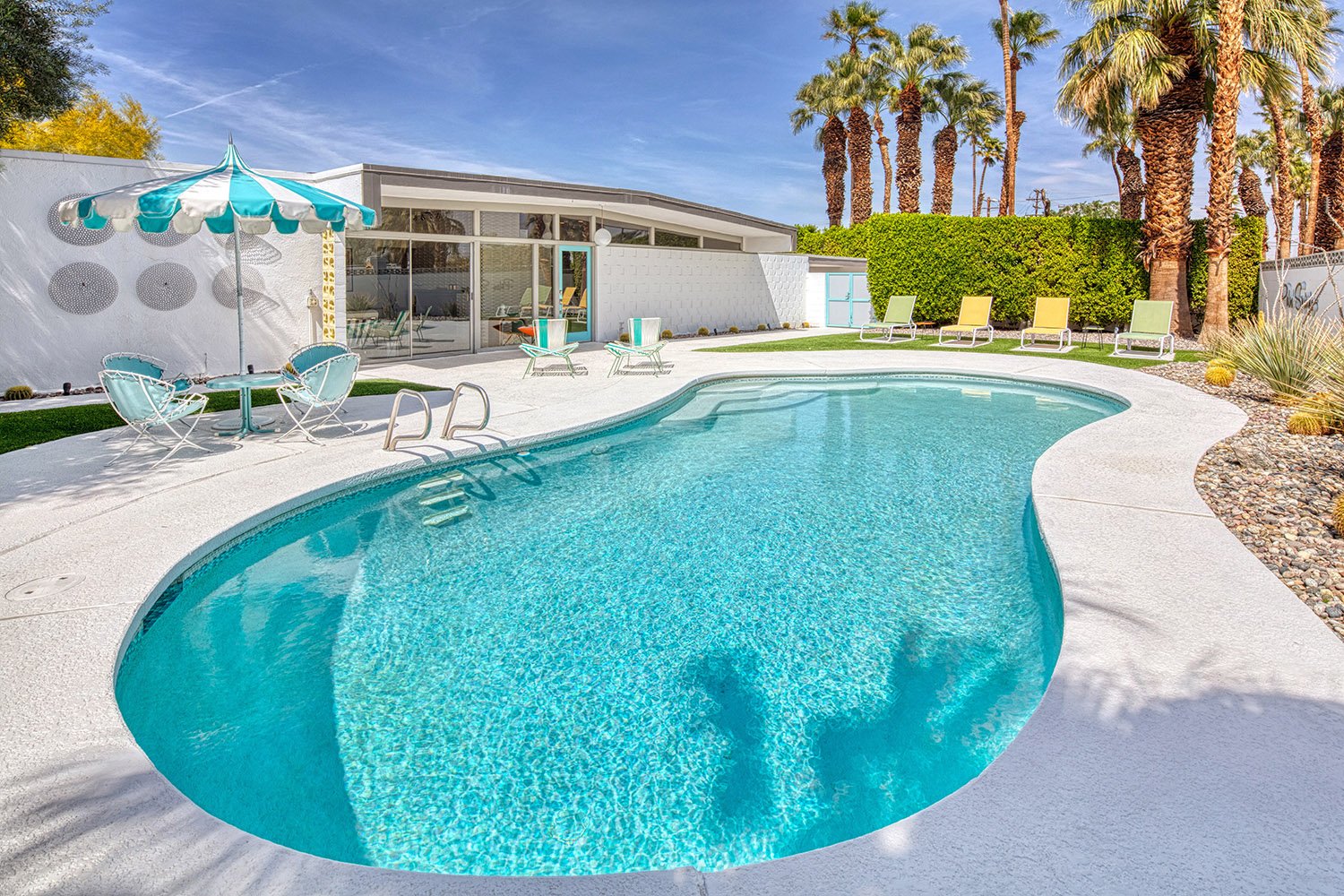
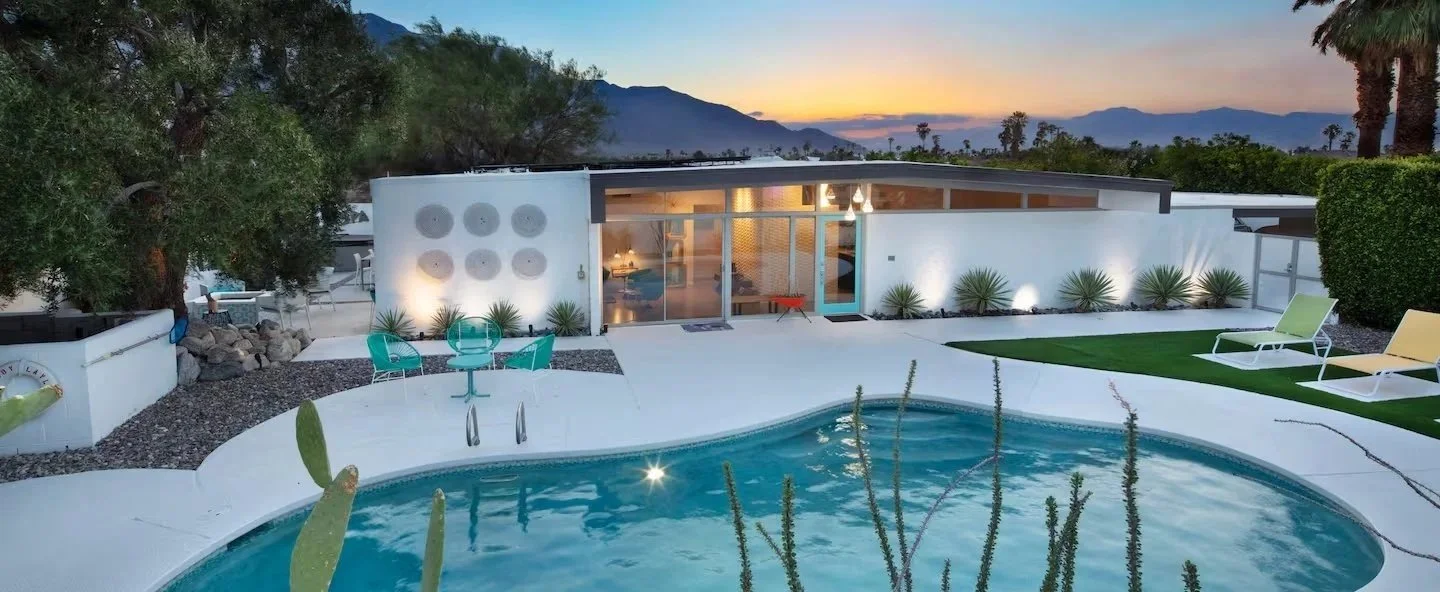
El Rancho Vista Estates is a cherished part of the historic mid century modern story, and holds a special place in the rich architectural history of Palm Springs. Designed by the renowned architectural team of Donald Wexler and Richard Harrison with developer Roy Fey, our neighborhood was built in three phases, Phase 1 & early Phase 2 between 1960-62, with late Phase 2, 3 and 4 transitioning into ranch design dwellings, being completed into the late 1970s under the guidance of builders Roy Fey and Joe Koch.
Originally fashioned as a stylish weekend retreat, ERVE was the city’s first planned residential subdivision designed by this visionary duo, whose modernist designs helped shape the broader mid century modern architectural movement.
As times changed and our city modernized, El Rancho Vista Estates has become a vision for full time desert living. With our clean lines and timeless designs helping shape the world renowned aesthetic of Palm Springs as we know it today. You can read more about our design legacy, our build story and the neighborhood preservation ethos our neighbors are dedicated to below.
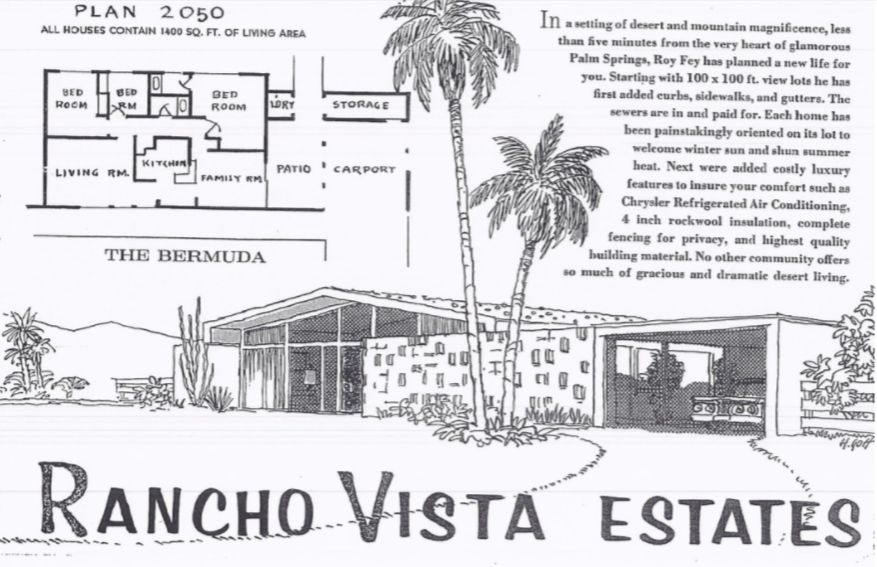
Original Neighborhood Advertising Material
-
![Illustration of a desert estate with a house plan, palm trees, and a building with outdoor seating, titled "Rancho Vista Estates."]()
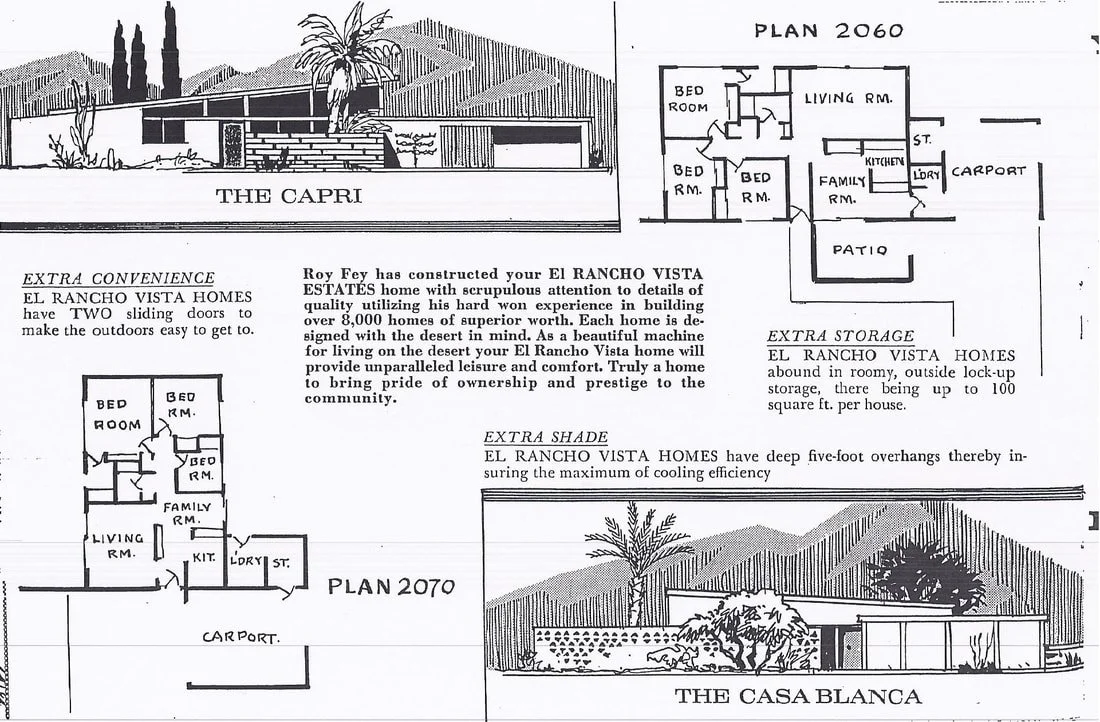
Original Floor Plans From Our 1960's Development Advertising
-
![Black and white architectural plans for two homes, 'The Capri' and 'The Casa Blanca', with descriptions emphasizing features like sliding doors, storage, shade, and layout, accompanied by illustrations of the homes' exteriors surrounded by desert landscape.]()
Original Floor Plans From Our 1960's Development Advertising
-
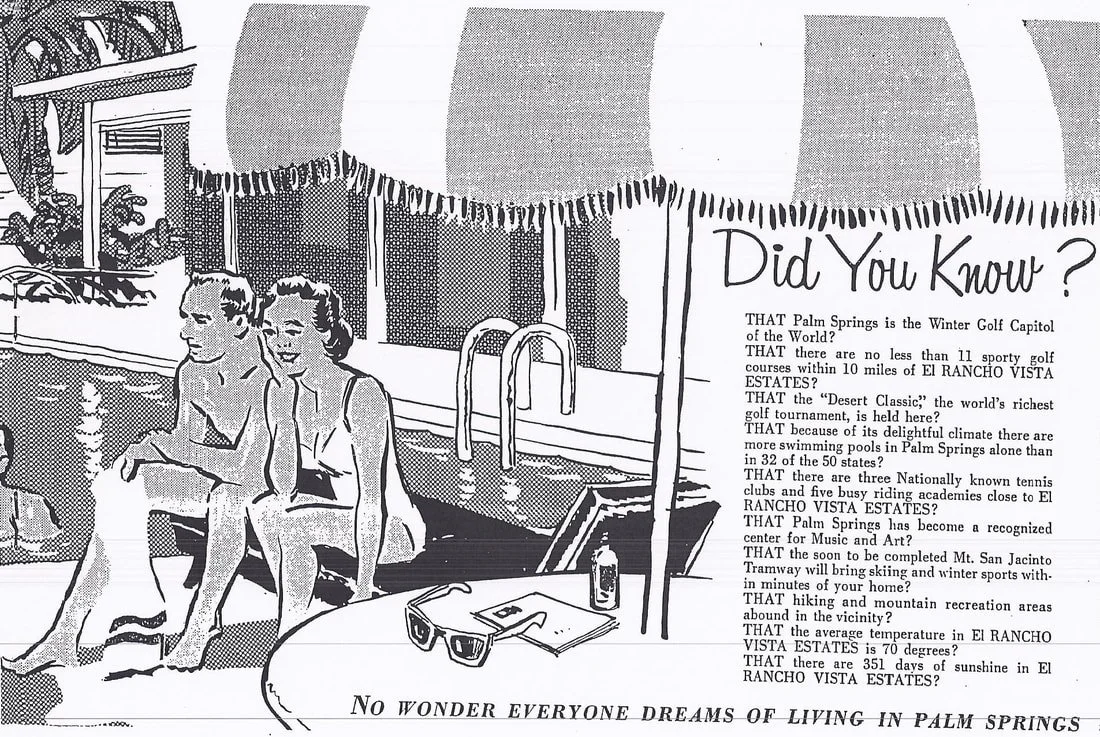
![Black and white illustration of a couple sitting poolside at a hotel or resort, with an informational pamphlet or poster in the background featuring facts about Palm Springs and El Rancho Vista Estates.]()
Original Promotional Material From Our 1960's Development Advertising
-
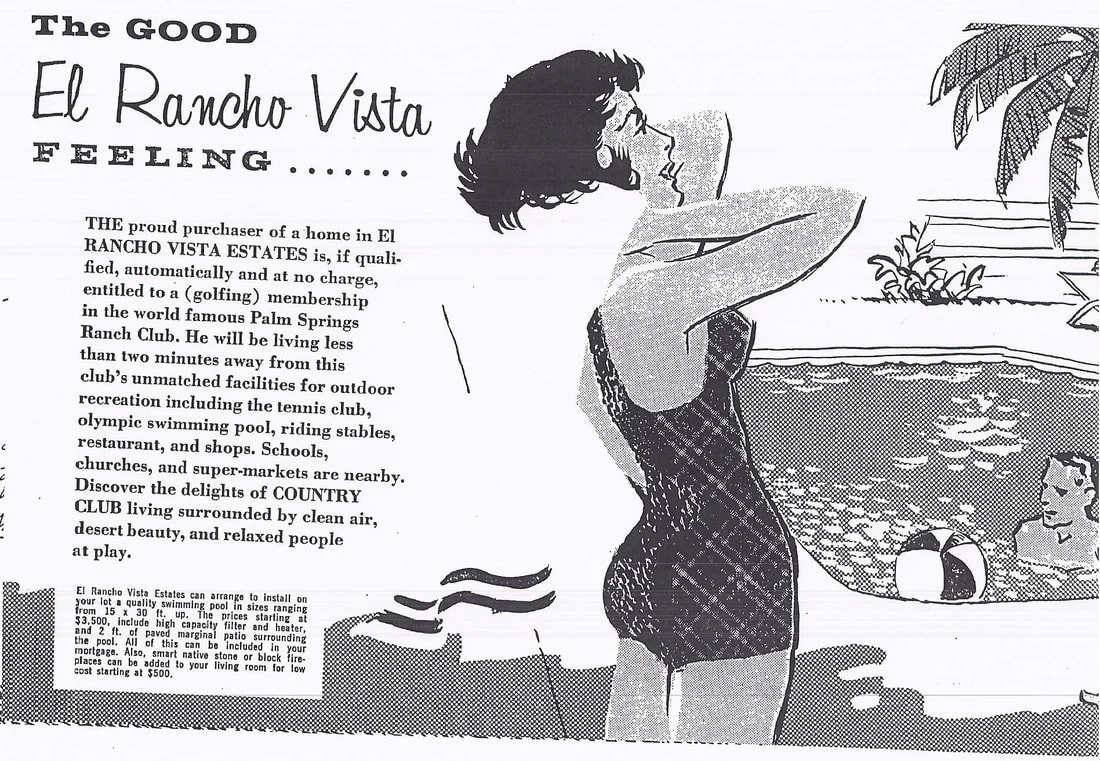
![Black and white illustration of a woman relaxing by a pool, with a young girl swimming in the pool, contrasted with promotional text for El Rancho Vista Estates highlighting local amenities and lifestyle.]()
Original From Our 1960's Development Advertising
-
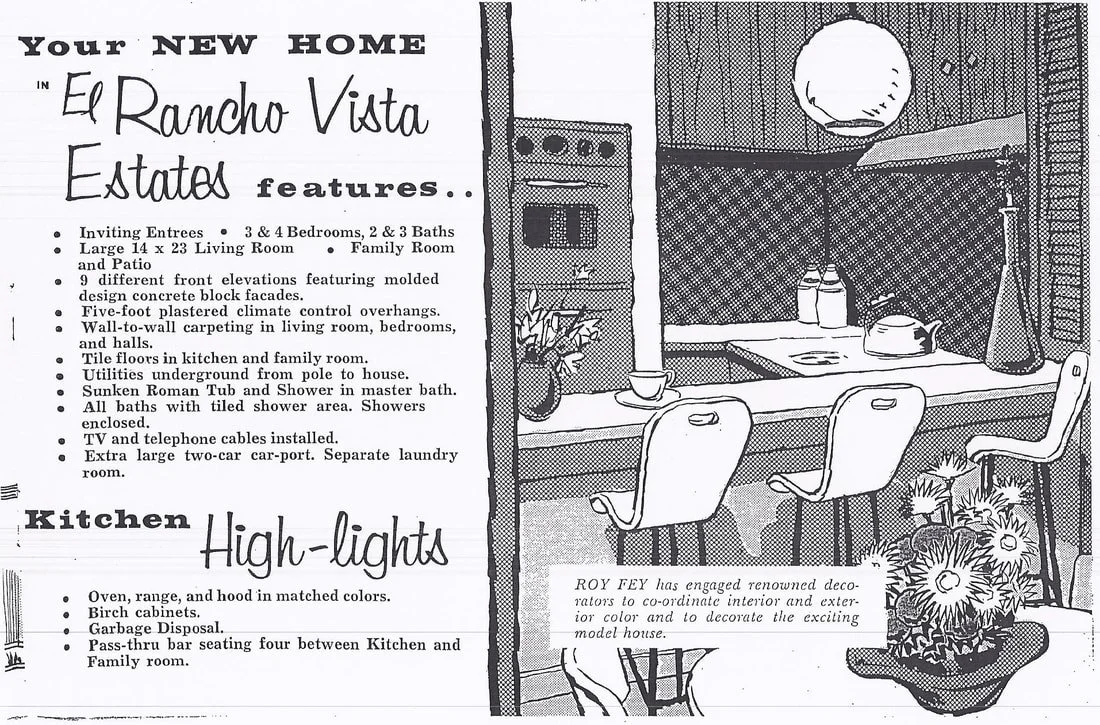
![A black and white advertisement for a new home in El Rancho Vista Estates, listing features like bedrooms, bathrooms, living spaces, outdoor features, flooring, plumbing, utilities, and laundry. There is a detailed illustration of a kitchen with a window, a pitcher, cups, and flowers on a counter, and a caption mentioning decorator Roy Fey.]()
Original Floor Plans From Our 1960's Development Advertising
-
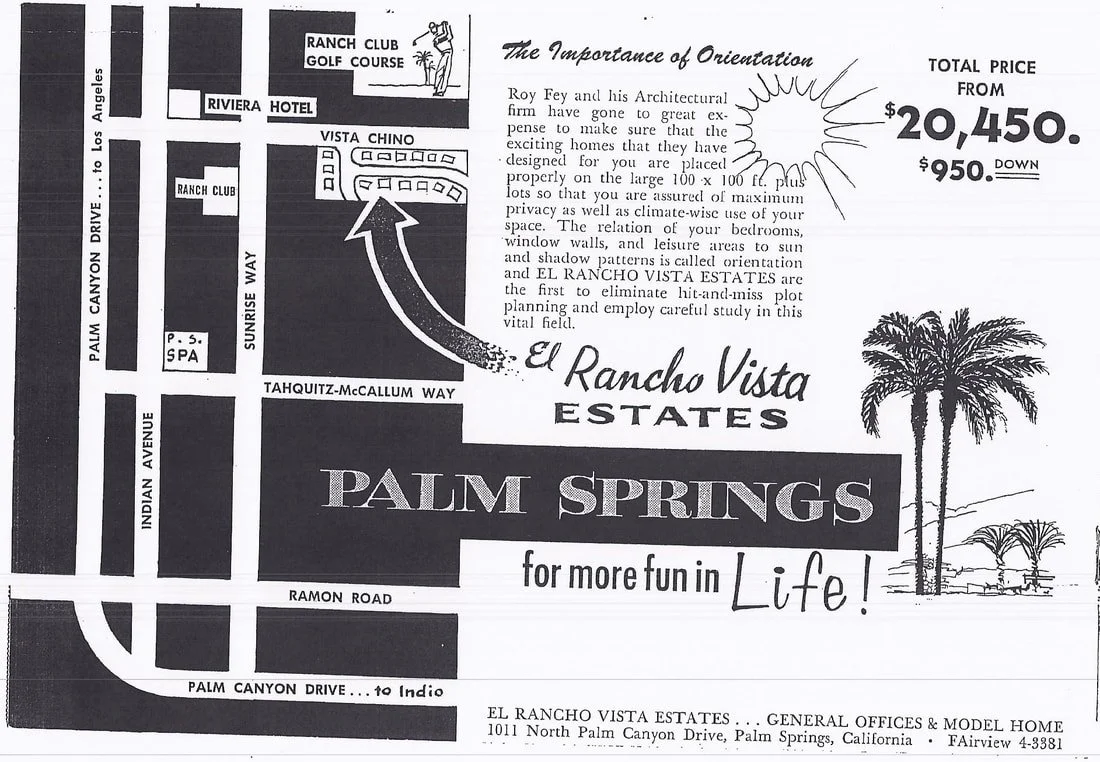
![Map of Palm Springs highlighting El Rancho Vista Estates, Rancho Club golf course, Riviera Hotel, and various streets like Palm Canyon Drive, Sunset Way, Tahquitz-McCallum Way, and Ramon Road. Also features illustrations of palm trees and promotional text about Palm Springs.]()
New List Item
-
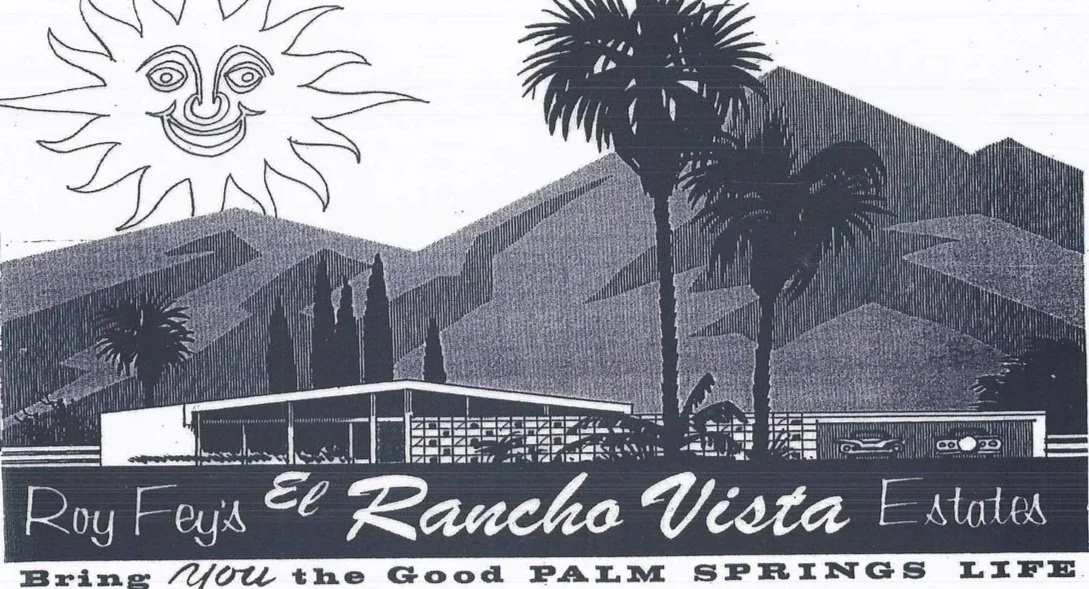
![A black and white vintage sign featuring a stylized smiling sun in the sky above mountains and palm trees, promoting El Rancho Vista Estates in Palm Springs, California.]()
Original Floor Plans From Our 1960's Development Advertising
A Vision For Modern Living
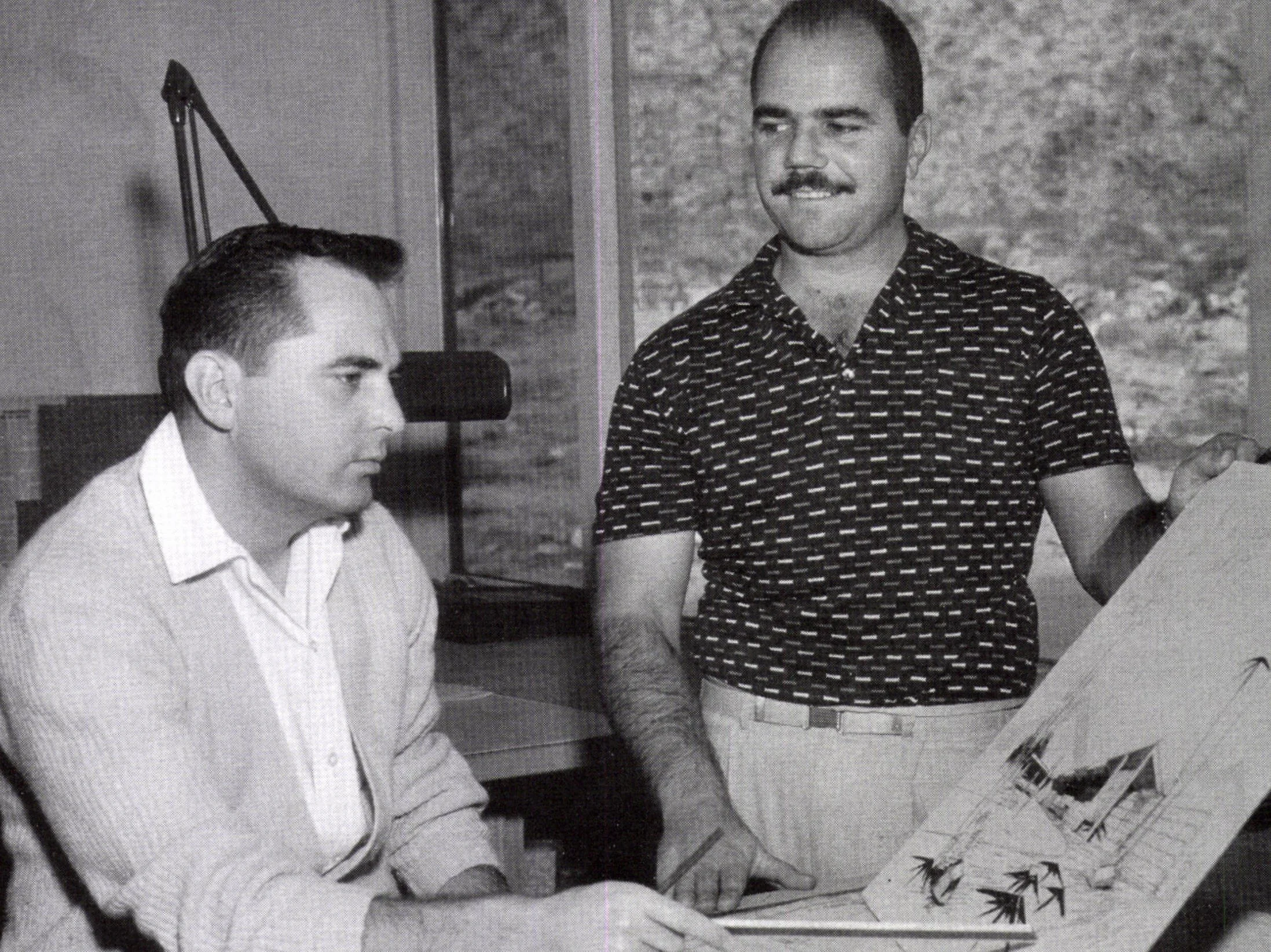
The first phases of approximately 71 homes in the neighborhood was developed by Roy Fey with architectural guidance by powerhouse design duo, Donald Wexler and Richard Harrison at the helm. Fey’s son Robert additionally contributed to ERVE’s early development.
Together, they sought to create a community of modern homes that combined striking architecture with the easy desert lifestyle. The goal was ambitious: bring contemporary design, once the domain of custom homes and high end clients, into an accessible, family-oriented subdivision. The first two phases of ERVE’s development were constructed between 1960-1964, with first residents, including famed fitness legend Jack LaLanne and his wife Elaine, moving in from 1961.
Fey later partnered with builder Joe Koch on an additional 39 homes built in California Ranch style from 1961, however these phases of the development were not designed with Wexler & Harrison.
At the time of its construction, El Rancho Vista Estates was the first Wexler & Harrison subdivision in Palm Springs to be marketed not just as vacation homes, but as residences for year round living.
Advertisements from the early 1960s highlighted the neighborhood’s modern conveniences and stylish design, appealing to both young families and retirees looking for something fresh in the desert.
Architecture And Design
Wexler and Harrison designed three distinct floor plans for Phase 1 & 2 and early 3 of El Rancho Vista Estates – the Bermuda, the Capri, and the Casablanca.
Each featured clean lines, post-and-beam construction, dramatic rooflines, and generous walls of glass that blurred the line between indoors and outdoors. Hallmarks of their work, such as clerestory windows, open floor plans, and integrated carports, gave the homes a sense of lightness and modernity.
El Rancho Vista Estates offered 10,000 sq ft lots and an optimized home orientation; for example, some houses sitting perpendicular to the street. Roy Fey stressed “The Importance of Orientation” in the original marketing material, noting that his firm carefully studied the orientation of the homes on each lot, arranging bedrooms and leisure spaces in a way that was optimized to utilize sun and shade in all seasons. Widely spaced lot positioning preserved privacy and scale for residents, maximizing San Jacinto Mountain views and a cohesive neighborhood identity.
While other neighborhoods in Palm Springs feature homes by Wexler and Harrison, El Rancho Vista Estates is unique as the first and only subdivision of single family homes located in the same neighborhood that they designed together in its entirety.
Preservation And Legacy
Today, El Rancho Vista Estates is recognized as a defining example of Palm Springs Modernism.
Its architecture continues to attract admirers from around the world, from design scholars to visitors attending the annual Modernism Week event programs, as well as being identified in the citywide survey inventory refresh due to it’s significant contribution to Palm Springs renowned architectural story and potential to pursue historic site designation, which would result in a Class 2 Historic Site classification.
ERVE’s residents have committed to maintaining much of the integrity of the original designs, while celebrating the timeless vision that Wexler, Harrison, and Fey set in motion more than sixty years ago.
ERVE is more than just a neighborhood. It’s a living piece of architectural history; a reminder of the optimism of the early 1960s, and a cornerstone of Palm Springs’ modernist legacy to be enjoyed for generations to come.